




Sony SDP-777ES Digital Surround Processor
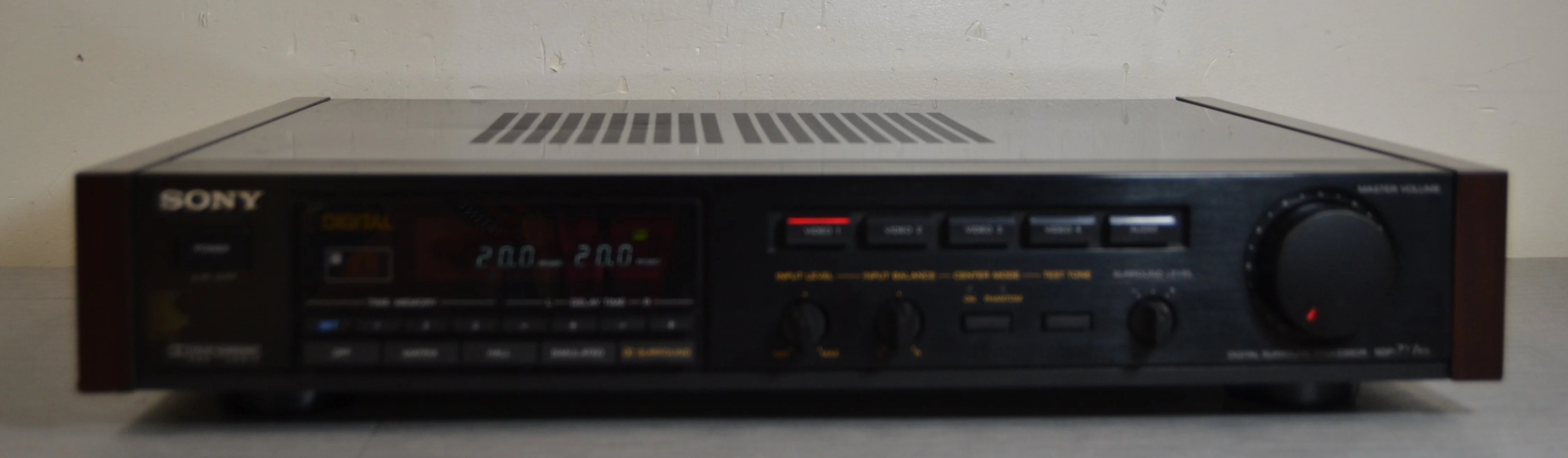
Sony SDP-777ES
Despite the QUAD debacle of the 1970s, the hifi industry still wanted four-channel to invade homes, to converge with the movie industry, and to be the next big thing.
So first, when CD was about to be launched, some protagonists tried to get CD to be a 4-channel format : Philips until may 1981 offered as "optional" the surround-sound compatibility with two discs glued back to back (like a Laserdisc), one being regular stereo, the other being 4-channel encoded.
Pioneer was into this, too, with its Model 1516 prototype which included decoding circuitry.
No go : the 1970s weren't that far in 1982 and everybody else thought sticking surround-sound into a surefire standard like CD would confuse the potential customers... again.
So it took a few more years for Yamaha to launch its DSP-1 and, gradually, all others followed in the late 1980s with standardized Dolby Pro-Logic decoders. And this time it worked - patience is a virtue.
The SDP-777ES isn't Sony's first DPL engine but one that sold well, especially in Japan, alongwith the contemporary ES amplifiers (TA-F800ES), tuners (ST-S730ES) and CD players (CDP-557ESD).
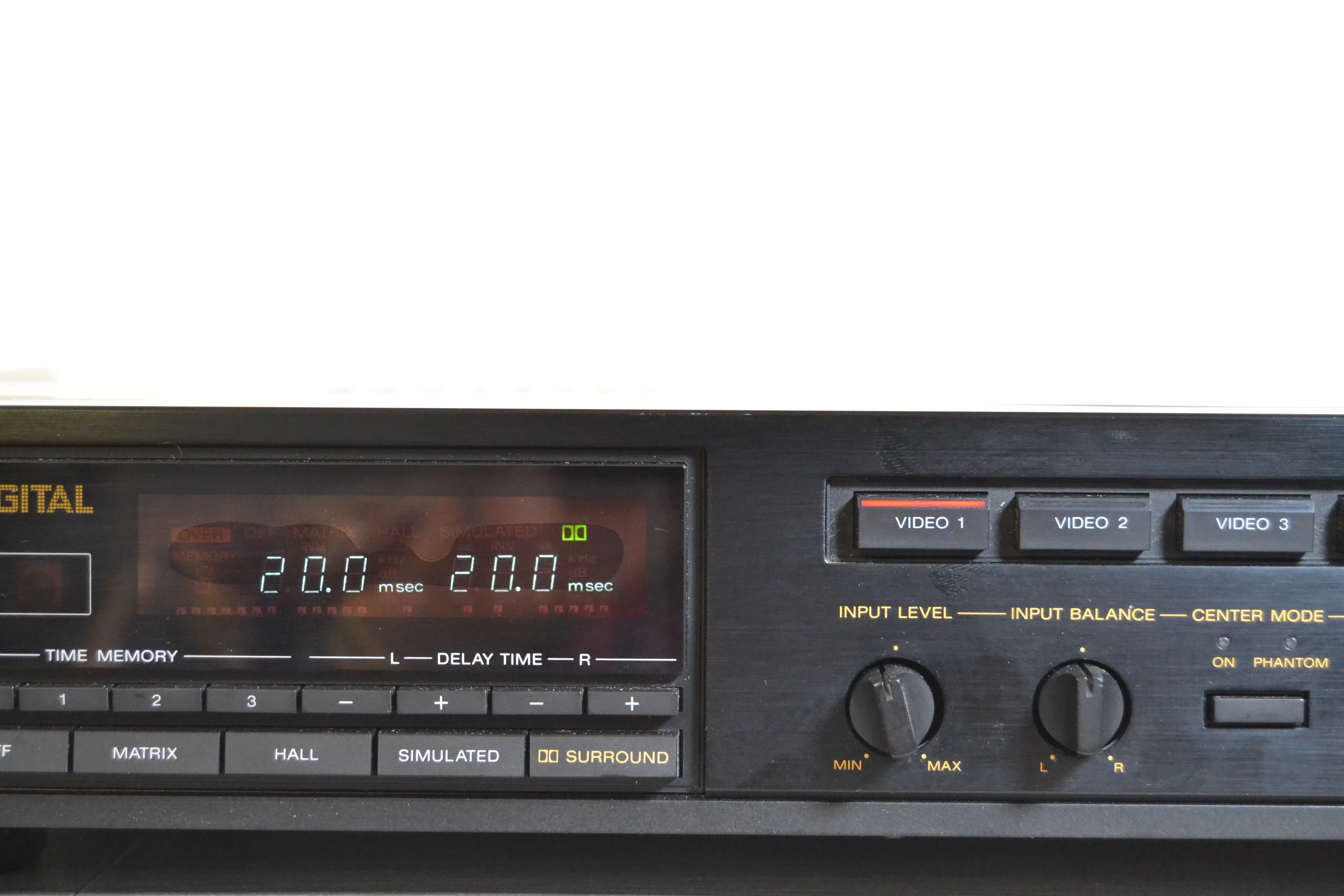
Centered around two Sony ICs, it allowed -and still does- to tweak everything, mostly by way of the IR remote control : front, center and back levels, surround modes, phase inversion, bass level for the subwoofer, delay times, subsonic filter for small center channel loudspeakers, pink noise generator.
Being a digital unit, the SDP-777ES is based on 16bit a/d and d/a circuitry ; the digital low-pass filter acts at 48Khz on 32bit (CXD-1160), also handling tone controls and compression/expansion, and 18bit calculating from the CXD-1355Q does the rest - digital attenuation, digital delay, reverb.
Contemporary Sony components giving a bit more work to these two early digital ICs are the big STR-D2010 or even the D-555 Discman - yes.
Original: $75.00
-65%$75.00
$26.25Product Information
Product Information
Shipping & Returns
Shipping & Returns
Description
Sony SDP-777ES
Despite the QUAD debacle of the 1970s, the hifi industry still wanted four-channel to invade homes, to converge with the movie industry, and to be the next big thing.
So first, when CD was about to be launched, some protagonists tried to get CD to be a 4-channel format : Philips until may 1981 offered as "optional" the surround-sound compatibility with two discs glued back to back (like a Laserdisc), one being regular stereo, the other being 4-channel encoded.
Pioneer was into this, too, with its Model 1516 prototype which included decoding circuitry.
No go : the 1970s weren't that far in 1982 and everybody else thought sticking surround-sound into a surefire standard like CD would confuse the potential customers... again.
So it took a few more years for Yamaha to launch its DSP-1 and, gradually, all others followed in the late 1980s with standardized Dolby Pro-Logic decoders. And this time it worked - patience is a virtue.
The SDP-777ES isn't Sony's first DPL engine but one that sold well, especially in Japan, alongwith the contemporary ES amplifiers (TA-F800ES), tuners (ST-S730ES) and CD players (CDP-557ESD).
Centered around two Sony ICs, it allowed -and still does- to tweak everything, mostly by way of the IR remote control : front, center and back levels, surround modes, phase inversion, bass level for the subwoofer, delay times, subsonic filter for small center channel loudspeakers, pink noise generator.
Being a digital unit, the SDP-777ES is based on 16bit a/d and d/a circuitry ; the digital low-pass filter acts at 48Khz on 32bit (CXD-1160), also handling tone controls and compression/expansion, and 18bit calculating from the CXD-1355Q does the rest - digital attenuation, digital delay, reverb.
Contemporary Sony components giving a bit more work to these two early digital ICs are the big STR-D2010 or even the D-555 Discman - yes.